

Introduction
In the realm of electronics, particularly in high-speed digital and RF circuits, the concept of common mode currents has both theoretical and practical implications. Common mode currents refer to currents that flow in the same direction on two or more conductors, often relative to a common reference plane, typically ground. This phenomenon is not just an academic interest but poses significant challenges in system design, signal integrity, and electromagnetic compatibility (EMC).
What are Common Mode Currents?
To understand common mode currents, let’s first differentiate them from differential mode currents:
- Differential Mode Currents: These are the intended currents for signal transmission, where the current flows in opposite directions on two conductors (e.g., the signal and return paths in a twisted pair).

- Common Mode Currents: These currents flow in the same direction on both conductors. They can be induced by various means:
- Crosstalk: Signals from adjacent lines can couple, creating common mode currents.
- Ground Loops: Differences in ground potential between different points can drive currents through the ground connections of circuits.
- Radiated Emissions: External electromagnetic fields can induce currents on both conductors simultaneously.
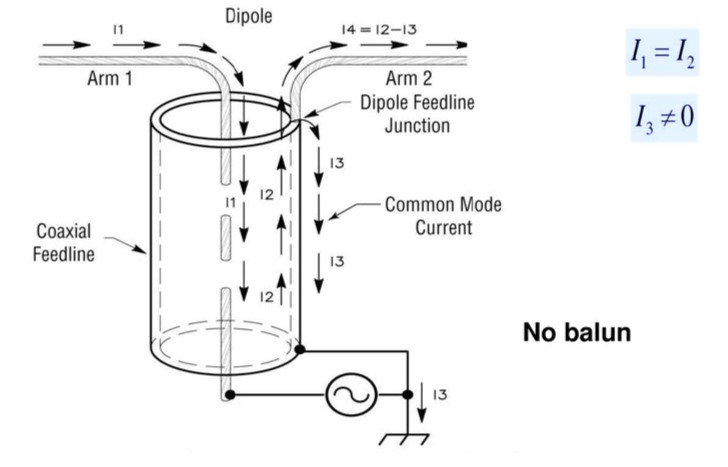
- RF applications, particularly amateur radio, common mode current refers to current travelling on the outside of the coaxial shield, which, unlike current on the inside of the shield, has no corresponding opposing current travelling through the core conductor.
Why Are Common Mode Currents Problematic?
Common mode currents are problematic for several reasons:
- Signal Integrity:
- Noise Introduction: Common mode currents can introduce noise into the system, degrading the signal-to-noise ratio. This noise can be particularly disruptive in high-precision analog circuits or high-speed digital interfaces where signal integrity is paramount.
- Electromagnetic Interference (EMI):
- Radiation: Common mode currents often do not have a well-defined return path, leading to unintended radiation. This can cause the device to fail EMI regulations, as it might interfere with other nearby electronic devices or systems.
- Circuit Stability:
- Ground Bounce: Large common mode currents can cause fluctuations in ground potential, known as ground bounce, which can affect the operation of circuits, particularly those with high-speed switching elements like microprocessors.
- Power Integrity:
- Power Supply Noise: If common mode currents flow through power supply lines, they can corrupt the DC voltage levels, affecting the power integrity for all devices connected to that supply.
Technical Challenges and Solutions
Mitigation Techniques:
- Balanced Lines: Using twisted pairs or differential signaling like LVDS (Low Voltage Differential Signaling) helps to cancel out common mode noise by ensuring currents are always flowing in opposite directions.
- Common Mode Chokes: These devices are designed to present a high impedance to common mode currents while allowing differential currents to pass with minimal loss. They are particularly useful in power supply lines and data cables.
- Grounding Strategies: Proper grounding techniques, such as star grounding or single point grounding, can minimise the loop areas where common mode currents might flow.
- Shielding: Enclosing sensitive circuits or using shielded cables can prevent external electromagnetic fields from inducing common mode currents.
- Filtering: Employing filters at the interface between different circuit sections or at cable entries can help in reducing the impact of common mode currents.
Design Considerations:
- Simulation and Modeling: Use of electromagnetic simulation tools to predict and mitigate common mode issues before physical prototyping can save considerable time and resources.
- Component Selection: Choosing components with lower EMI characteristics or those specifically designed to filter, or otherwise handle, common mode noise can be crucial.
Conclusion
Understanding and controlling common mode currents is vital in modern electronic design. These currents, while often invisible in schematics, can lead to significant operational issues ranging from minor signal degradation to complete system failure or non-compliance with regulatory standards. By applying the right mix of design strategies, components, and testing methodologies, engineers can mitigate these effects, leading to more robust and reliable electronic systems.