

When working with high-frequency RF (Radio Frequency) products, selecting the right coaxial cable is crucial for maintaining signal integrity, achieving the desired performance, and ensuring reliability over time. Here’s a comprehensive guide to help you navigate through the selection process:
Coaxial Cable Overview
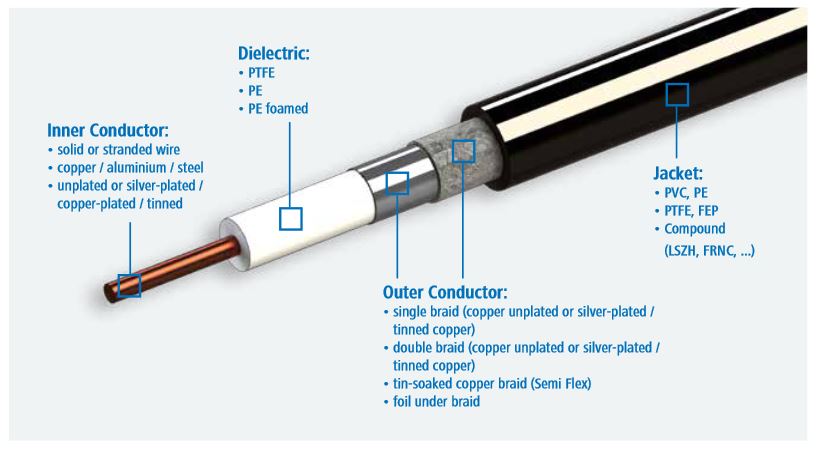
Coaxial cables are designed to carry a wide range of frequencies with minimal loss. They consist of:
- Inner Conductor / Core: Usually copper or copper-clad steel, which carries the electrical signal.
- Dielectric Insulator: This non-conductive layer keeps the signal within the conductor. Common materials include polyethylene, Teflon, and foam.
- Shielding / Outer Conductor: Typically made from braided copper with an inner foil shield, it prevents signal loss due to electromagnetic interference (EMI)
- Jacket: The outer layer, often PVC or LSZH (Low Smoke Zero Halogen), provides protection from physical damage, moisture, and chemicals.
Factors to Consider
1. Attenuation
- Cable Length: Longer cables increase signal loss. Choose a cable with acceptable attenuation for your required length.
- It’s best to use attenuation charts provided by manufacturers, such as the example shown below, to select a cable where the modelled loss at your operational frequency is acceptable. For example, RG-213 has attenuation of 38 dB per 100 metres at 2 GHZ (see table below), compared to RG-178, which has 239 dB per 100 metres at 2 GHz. In practical terms, this means that signal power after travelling through one metre of RG213 cable is 91.6% of its initial magnitude, but would be 57.7% of its initial magnitude, suffering much higher loss of power, after travelling through one metre of RG-178 (1÷10 to the power 239÷100÷10).
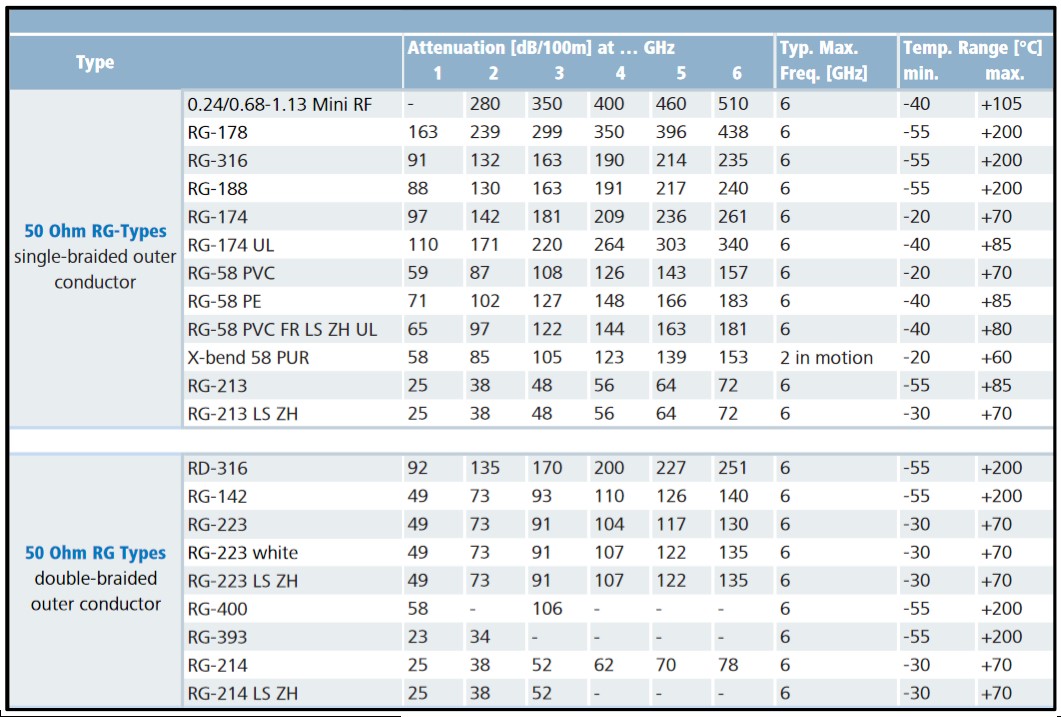
Bear in mind that attenuation also occurs due to connectors, which is additional to the calculations derived above.
2. Power Handling
- Power Capacity: Ensure the cable can handle the power you intend to transmit without risk of breakdown or overheating.
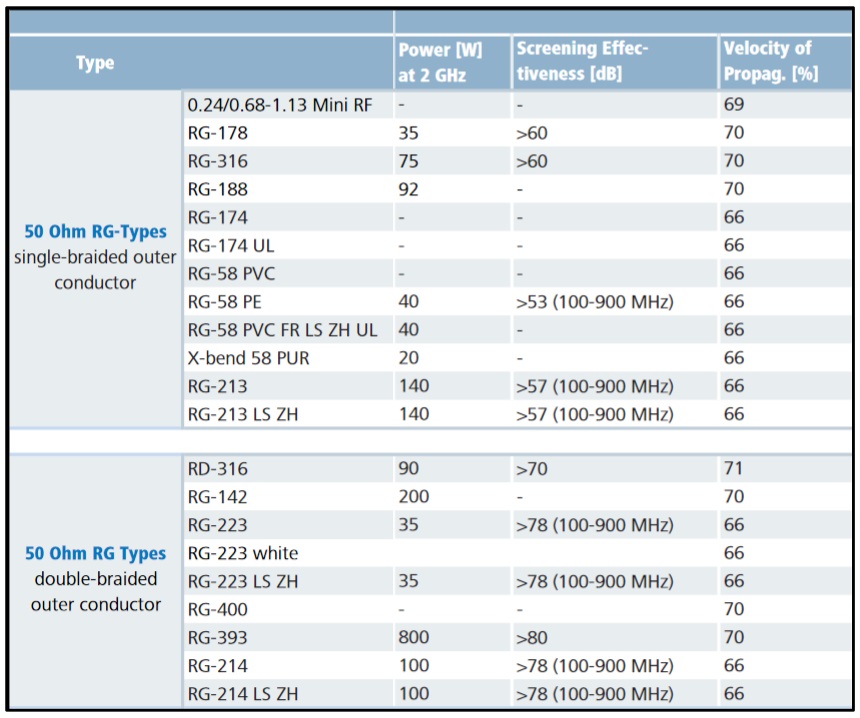
- For high power, larger diameter cables like RG-213 (rated for 140 W at 2 GHz) or RG-142 (rated for 200 W at 2 GHz) are often necessary. See the chart below.
3. Impedance
- Characteristic Impedance: Typically, 50 ohms for RF applications, though 75 ohms are used in some TV and video applications. Mismatch in impedance can lead to signal reflection and loss. Where necessary, a balun can be used to match impedances between subsystems.
4. Flexibility and Durability
- Application Environment: If the cable will be moved frequently or installed in harsh conditions, consider:
- Flexible options like RG-178 with a stranded center conductor for flexibility. Check specified minimum bend radius of each option.
- Robust materials like double-shielded or tri-shielded cables for better EMI protection.
6. Connector Compatibility
- Connectors: Ensure the cable’s diameter matches with BNC, SMA, N-Type, or other connectors that are compatible with your equipment.
- Proper connector mating reduces signal loss/reflection and ensures better durability and more mating cycles.
7. Environmental Considerations
- Temperature: Polyethylene and Teflon dielectrics handle different temperature ranges.
- Teflon (PTFE) is excellent for high temperatures.
- Consult specifications for minimum and maximum temperatures if your application requires a specific resilience.
- Moisture and UV Resistance: For outdoor use, choose jackets designed for these conditions.
8. Other
- Screening effectiveness: Not all cables are equally effective for minimising electromagnetic interference (EMI) both from and into the cable.
- Frequency Range Some cables will only provide satisfactory performance to 3 GHz or below, while come are rated to as high as 40 GHz.
Steps to Choose Your Coaxial Cable
- Identify Needs: Define the frequency, power, and environmental conditions of your application.
- Research: Check manufacturer specifications for attenuation, power handling, and impedance.
- Sample Testing: If possible, test samples of the cable with your equipment to ensure optimal performance.
- Cost vs. Performance: Higher quality cables might cost more but could be necessary for critical applications where signal integrity or system longevity is paramount.
- Consult Experts: Sometimes, consulting with technical support can provide insights tailored to your specific needs.
Conclusion
Selecting the right coaxial cable for high-frequency RF applications involves balancing various technical specifications with practical considerations such as cost, application criticality, future replacement schedule etc. Remember, the cheapest option isn’t always the best in terms of performance or longevity. By understanding your requirements and the properties of different cables, you can ensure your RF system operates at peak efficiency.